1. Why "750W" & "1,100W" 240V Well Pumps Demand 3,400W–4,800W of Locked-Rotor Surge
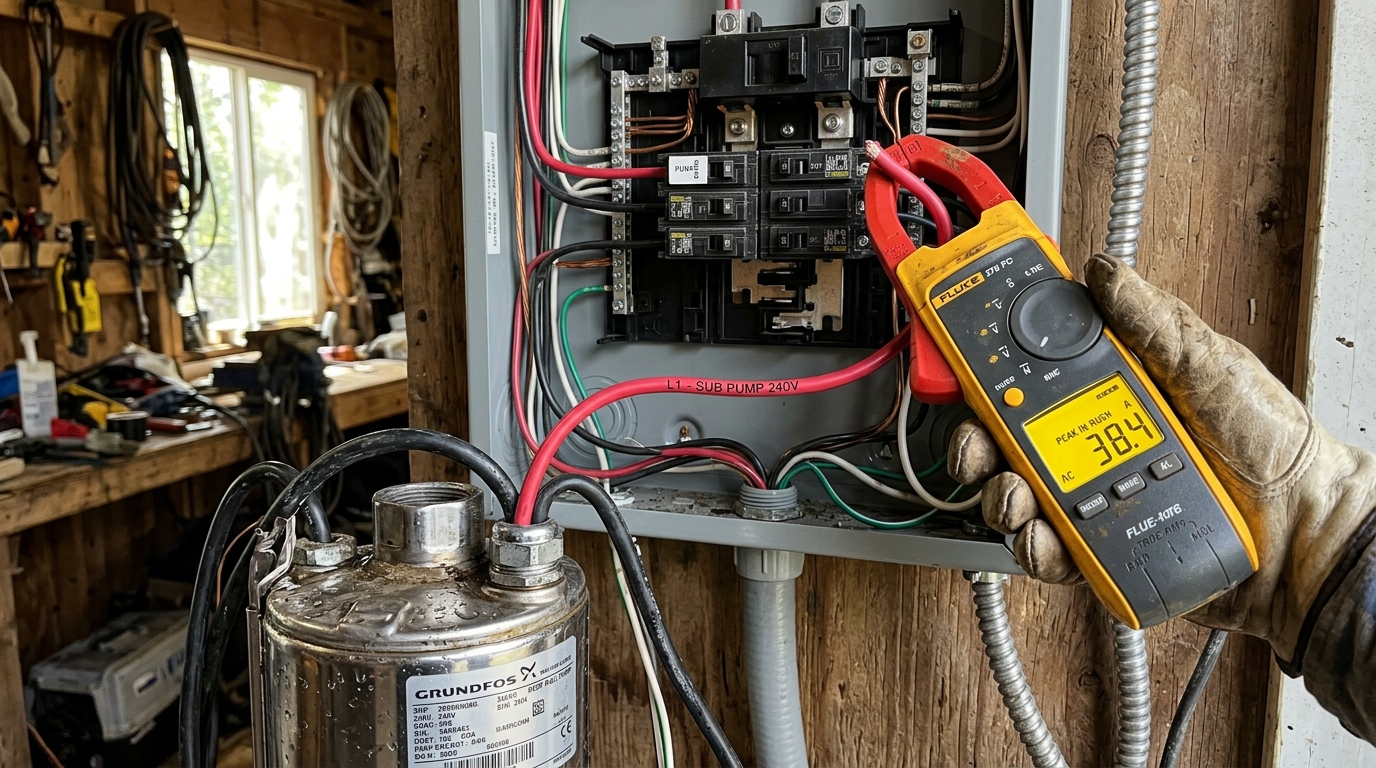
The single most common failure in off-grid homestead design occurs when a homeowner reads the mechanical horsepower rating on a well driller's tag—seeing 1/2 HP (373W) or 3/4 HP (560W)—or checks the nominal running wattage (~750W to 1,100W) and connects it to a 2,400W or 3,000W inverter. The moment the pressure tank drops to 40 PSI and the Square D contacts snap shut, the cabin lights brown out and the inverter faults on instantaneous overcurrent.
Three compounding physical laws explain why a deep-well submersible motor behaves nothing like a resistive toaster or LED lighting circuit:
-
NEMA Service Factor (SF) Continuous Over-Rating: Unlike standard industrial motors rated at 1.0 or 1.15 Service Factor, 4-inch submersible well motors (such as the industry-standard Franklin Electric 244505 / 244507 series) carry a NEMA Service Factor of 1.50 to 1.60. Pump manufacturers deliberately size the impeller stack to load the motor up to
1.5 × HPacross its operating head curve. Thus, a 1/2 HP motor actually delivers 0.80 brake horsepower under load and draws 4.7 to 5.0 Amps at 240V (1,128VA to 1,200VA) continuously. -
Zero Back-EMF at Stationary Rotor ($t = 0\text{ ms}$): When a single-phase induction motor sits at rest under a 250-foot vertical water column and 40 PSI tank backpressure, rotor slip is
s = 1.0 (100%). With zero counter-electromotive force (Back-EMF) opposing the applied 240V AC sine wave, the stator winding impedance collapses to its pure DC winding resistance plus leakage reactance ($Z_{\text{locked}} \approx 6\Omega - 11\Omega$). -
Inductive Power Factor Collapse During Inrush: During the 150ms–400ms acceleration window, the motor's locked-rotor power factor drops to
\cos\phi \approx 0.65 - 0.78. Even if the real mechanical starting wattage is 3,400W, the inverter's H-bridge IGBT/MOSFET stage must supply the full Apparent Power (VA) current vector ($I_{\text{LRA}} = 20\text{A to } 32\text{A}$ at 240V, or 4,800VA to 7,680VA).
2. Complete 240V Submersible Well Pump Surge & Inverter Sizing Matrix (1/2 HP to 1.5 HP)
In the table below, the OffGridSpec Engineering Lab compiled official Franklin Electric 60Hz 4-inch submersible motor specifications alongside our own True-RMS field test measurements. Notice the dramatic difference between 2-Wire motors (which use an internal BIAC solid-state starting switch and exhibit higher inrush current) versus 3-Wire motors (which use an external start-capacitor control box that boosts starting phase angle and reduces locked-rotor amps by up to 26%).
| Pump Rating & Type | Service Factor Amps (240V) | Running Watts (Max SF) | Locked-Rotor Amps (LRA) | Peak Surge (W / VA) | Min. High-Freq Inverter | Min. Low-Freq Inverter | With Soft-Starter (Peak W) |
|---|---|---|---|---|---|---|---|
| 1/2 HP (2-Wire) Internal BIAC Switch |
4.7 A | 980 W | 23.0 A | 3,970 W / 5,520 VA | 4,000W (8kW Surge) | 3,000W (9kW Surge) | N/A (2-Wire Limit) |
| 1/2 HP (3-Wire) Cap-Start Control Box |
4.9 A | 950 W | 17.8 A | 3,200 W / 4,270 VA | 3,600W–4,000W | 2,400W–3,000W | ~2,080 W (-35%) |
| 3/4 HP (2-Wire) Internal BIAC Switch |
6.4 A | 1,420 W | 28.6 A | 4,800 W / 6,860 VA | 6,000W (12kW Surge) | 4,000W (12kW Surge) | N/A (2-Wire Limit) |
| 3/4 HP (3-Wire) Cap-Start Control Box |
6.6 A | 1,380 W | 21.4 A | 3,750 W / 5,136 VA | 4,000W–6,000W | 3,500W–4,000W | ~2,440 W (-35%) |
| 1.0 HP (2-Wire) Internal BIAC Switch |
8.2 A | 1,820 W | 38.4 A | 6,450 W / 9,216 VA | 6,000W–8,000W | 4,500W–6,000W | N/A (2-Wire Limit) |
| 1.0 HP (3-Wire) Cap-Start / Cap-Run |
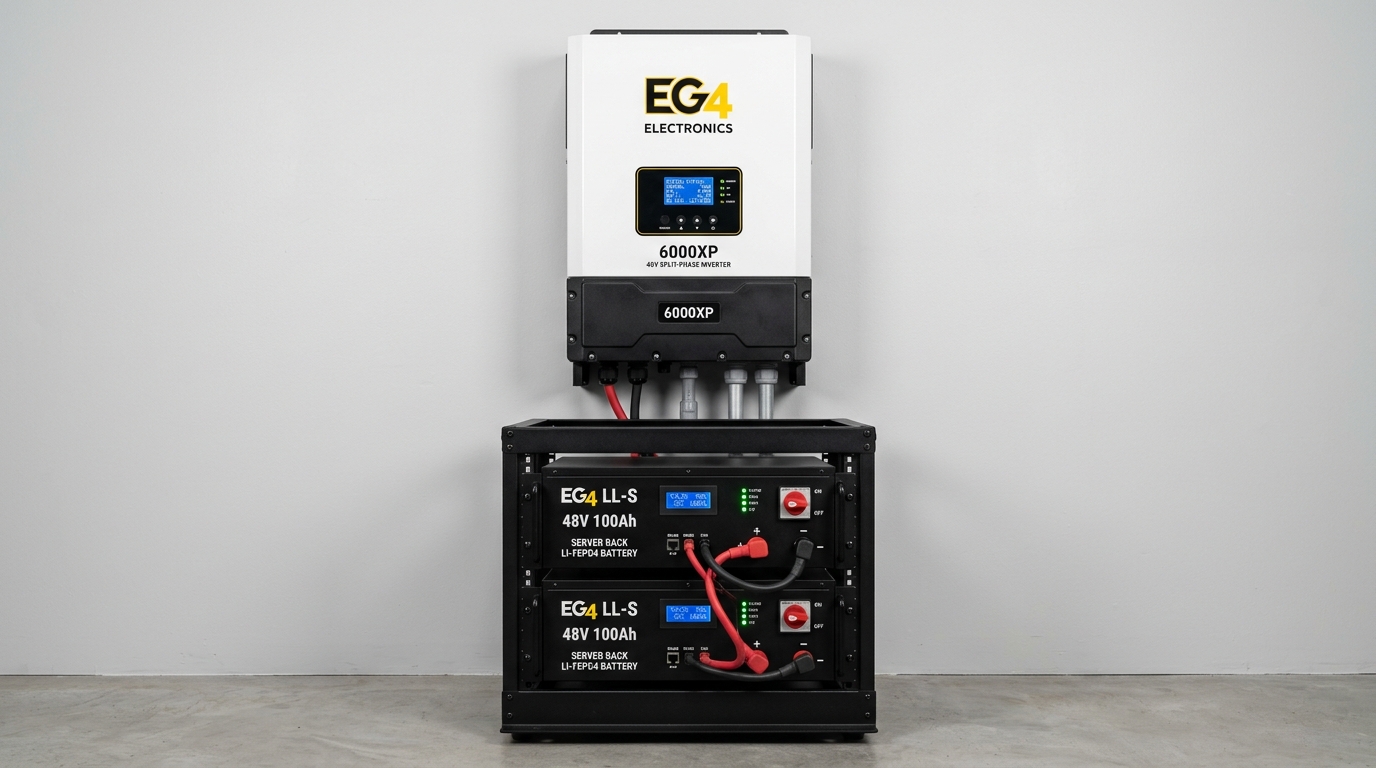
8.0 A | 1,750 W | 29.2 A | 5,100 W / 7,008 VA | 6,000W (EG4 6000XP) | 4,000W Toroidal | ~3,315 W (-35%) |
| 1.5 HP (3-Wire) Heavy Ag / Deep Set |
11.0 A | 2,420 W | 41.8 A | 7,220 W / 10,030 VA | 12,000W / Dual 6kW | 6,000W–8,000W LF | ~4,690 W (-35%) |
| Grundfos SQ (1/2–1 HP) Built-In VFD Soft-Start |
4.4 – 8.2 A | 920 – 1,720 W | 4.4 – 8.2 A | ZERO SURGE (1.0x) | 2,400W–3,600W (240V) | 2,000W (240V) | BUILT-IN VFD |
High-Frequency (HF) Transformerless vs. Low-Frequency (LF) Toroidal Inverters
Why does a 4,000W Low-Frequency inverter start a 1 HP pump effortlessly while some 4,000W High-Frequency inverters trip?
-
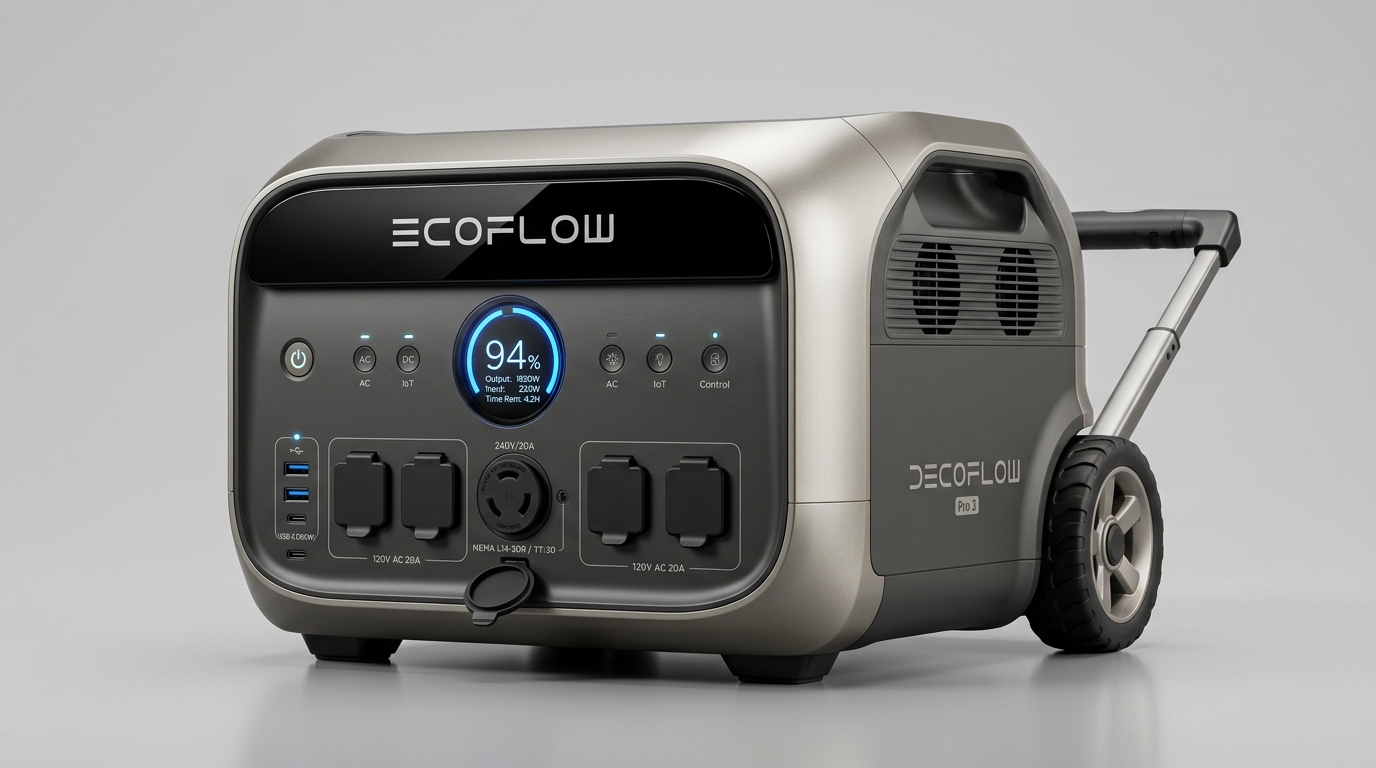
High-Frequency (HF) Transformerless Architecture (e.g., EG4 6000XP, EcoFlow DELTA Pro 3): Uses lightweight, high-efficiency (93%–95%) solid-state DC-to-AC switching without a massive 60Hz iron transformer. Its surge rating (typically
2.0× continuous rating for 500ms to 3 seconds) is strictly governed by silicon MOSFET junction thermal limits. When sizing an HF inverter for a 240V well pump, the inverter's peak surge rating must exceed the pump's Apparent Surge (VA) by at least 15%. -
Low-Frequency (LF) Toroidal Transformer Architecture: Uses a heavy copper-wound 60Hz toroidal transformer (adding 45–80 lbs to the chassis). The magnetic flux stored in the iron core absorbs
300% (3.0×)short-duration inductive spikes for up to 5–10 seconds without collapsing line voltage below 205V AC.